In this article
Settling the frontier — Why proof, not more potential, is what pharma content teams need next


Your download is ready
Unlock full video
Get the whitepaper
Submit your contact details to watch the entire webinar.
Submit your contact details to download the whitepaper.
Heading 2

Heading 3
Heading 4
Heading 5
Heading 6
Lorem ipsum dolor sit amet, consectetur adipiscing elit, sed do eiusmod tempor incididunt ut labore et dolore magna aliqua. Ut enim ad minim veniam, quis nostrud exercitation ullamco laboris nisi ut aliquip ex ea commodo consequat. Duis aute irure dolor in reprehenderit in voluptate velit esse cillum dolore eu fugiat nulla pariatur.
Lorem ipsum dolor sit amet, consectetur adipiscing elit, sed do eiusmod tempor incididunt ut labore et dolore magna aliqua.
Ordered list
- Item 1
- Item 2
- Item 3
Unordered list
- Item A
- Item B
- Item C
Bold text
Emphasis
Superscript
Subscript
Digital advertising
Marketing email
Social media
3rd party networks
Digital advertising
Marketing email
Social media
3rd party networks
Digital advertising
Marketing email
Social media
3rd party networks
Deliver a better experience by connecting channels & content.
Track HCP interactions to improve marketing and services.
Deliver a better experience by connecting channels & content.
Deliver a better experience by connecting channels & content.
Deliver a better experience by connecting channels & content.
Deliver a better experience by connecting channels & content.
Deliver a better experience by connecting channels & content.
Track HCP interactions to improve marketing and services.
Deliver a better experience by connecting channels & content.
The trouble with frontiers
In our last two posts, we mapped the new territory of content performance. First, the paradox of choice: pharma has a suite of tech tools available to it, but that abundance can be paralysing. Second, the final frontier: even with a unified platform, the actual work of turning approved modules into live, working assets is a slow, manual crossing so long as Activator doesn’t turn it into an engine.
Even with an existing platform and engine, if you asked most brand teams whether their organisation has genuinely changed how it works, most would say no.
This is the part that nobody puts in the product demo: technology doesn’t settle anything by itself. A frontier crossed once isn’t a frontier settled. What turns capability into a habit, a new default way of working, is proof. Teams need to see it work, trust that it holds, and use it without having to be talked into it every time.
Why capability alone doesn’t stick
Plenty of good pharma tech dies quietly in year two because nobody built the muscle memory to keep using it. A brand team runs one successful pilot, gets the case study slide, and then drifts back to the old agency-brief-and-wait cycle the moment the pressure’s off.
That’s because a platform only proves itself once, in a demo. A way of working has to prove itself every week, under normal conditions, to normal people who didn’t choose it. If MLR doesn’t trust the approval trail, they’ll ask for the old review anyway. If a local affiliate can’t tell whether a module is current, they’ll rebuild it from scratch just to be safe. Every one of those small reversions quietly rebuilds the bottleneck you just spent a year dismantling.
What proof actually looks like
Proof is the accumulation of small, visible confirmations that the new way is both faster and safer than the old one.
Mubasher Hassan, Global Head of Content Management at Grünenthal, makes this point plainly: pairing Activator with modular content in Veeva Vault PromoMats is “a really nice combination.” This is the kind of understated, working-level endorsement that tells you a tool has become infrastructure rather than an initiative. Nobody writes a case study about the CRM they’ve used for ten years. They just use it.
When a platform stops being something teams are asked to adopt, and becomes something they’d complain about losing, you know you’re making progress.
MLR as an ally
The fastest way to lose ground on a new content process is to let MLR experience it as more work in a different outfit. The fastest way to win them permanently is to give them less to do, visibly.
A traffic-light view of approval status, a full development history attached to every module, a clear line between what’s been reviewed and what’s new: none of this is glamorous, but it’s what converts MLR from gatekeepers who slow adoption into advocates who defend it. Once reviewers trust the system’s record-keeping more than their own memory of a thread of email approvals, the process holds under pressure, including the pressure of a launch deadline, which is the only pressure that actually matters.
Local teams as the real test
Global content strategy is easy to sell to global teams. It’s proven only when a local affiliate, who is busy and sceptical, with their own deadlines and their own regulator, chooses to use the master template instead of building their own workaround.
That choice only happens when the local version is genuinely faster to produce than going rogue. Side-by-side comparison views, easy localisation into standard formats, visible version control: these are the difference between a global asset that gets used everywhere and one that gets quietly ignored in every market except the one it was built for.
From pilot to default
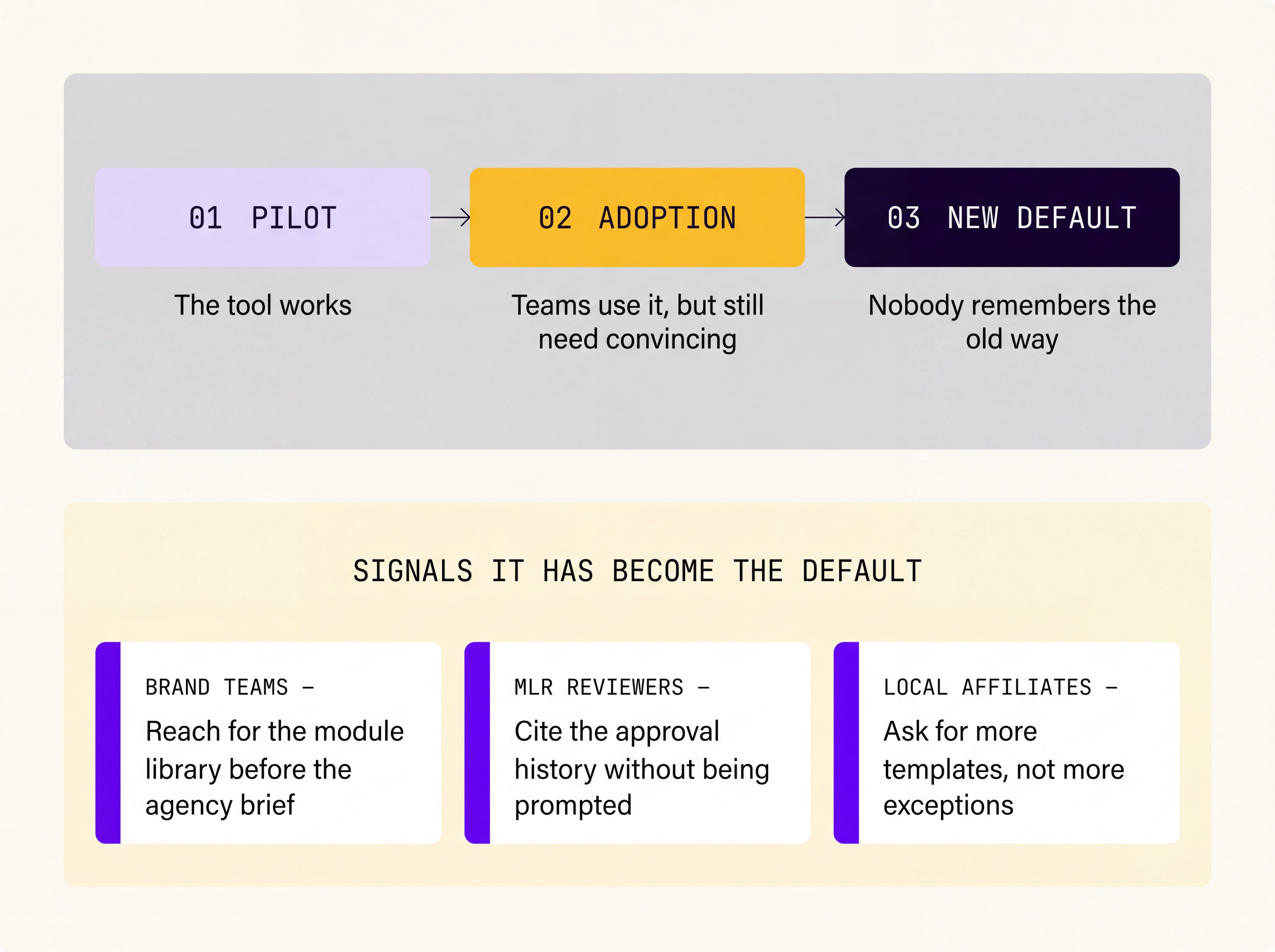
A pilot proves the tool works, but it doesn’t prove the organisation has changed. Watch instead for the quieter signals: teams that reach for the module library before they reach for the agency brief; MLR reviewers citing the approval history without being prompted; and affiliates asking for more templates rather than more exceptions.
That is how you know when a frontier is properly settled: when nobody can quite remember doing it the old way.
See it settle in your organisation
We’ve walked through the complexity (post one) and the engine that cuts through it (post two). The next step is watching Activator handle your content, your modules and your MLR workflow.
{cta-41, theme=dark}

View the full article
Watch full recording
Get the whitepaper
Submit your contact details to unlock.
Submit your contact details to watch the entire webinar.
Submit your contact details to download the whitepaper.
Meet the experts
Are you leveraging all channels?
See productin action.
See productin action.
See productin action.
Speak to an expert and get an in-depth evaluation of your omnichannel setup.


Seeproductin action.
Seeproductin action.
Seeproductin action.